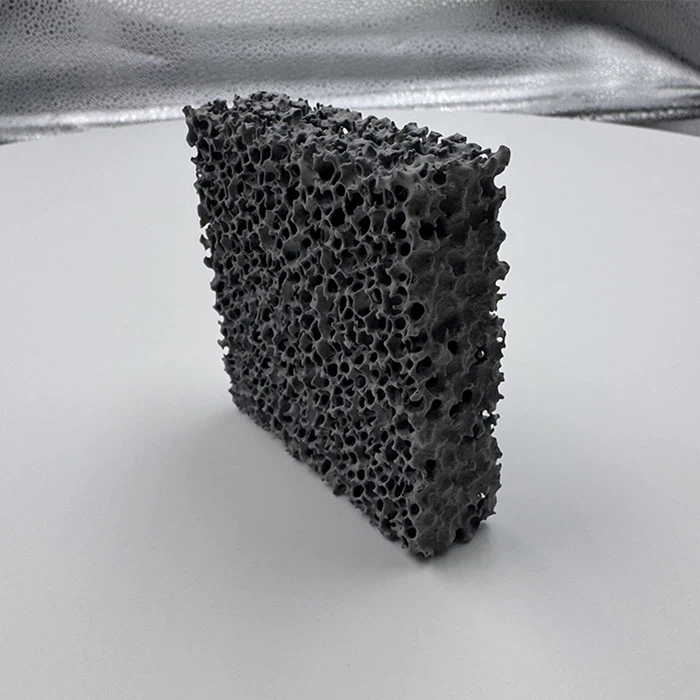
Hey there! As a supplier of Silicon Carbide Ceramic Foam Filters, I often get asked about the coefficient of thermal expansion of these filters. It’s a crucial property that affects how the filters perform under different temperature conditions. So, let’s dive into it and see what this coefficient is all about. Silicon Carbide Ceramic Foam Filter
First off, what is the coefficient of thermal expansion (CTE)? Well, it’s a measure of how much a material expands or contracts when its temperature changes. It’s usually expressed in units of parts per million per degree Celsius (ppm/°C). A high CTE means the material expands a lot when heated, and contracts a lot when cooled. A low CTE, on the other hand, means the material doesn’t change its size very much with temperature.
Now, let’s talk about Silicon Carbide Ceramic Foam Filters. Silicon carbide (SiC) is a well – known material with some pretty amazing properties. It’s super hard, has high thermal conductivity, and is resistant to corrosion. When it comes to the CTE of silicon carbide, it’s relatively low compared to many other materials.
The CTE of silicon carbide ceramic foam filters typically ranges from about 4 to 5 ppm/°C. This low CTE is a huge advantage for these filters. In applications where they are used, such as in the metal casting industry, the filters are exposed to high temperatures. When molten metal is poured through the filter, the temperature can be really high. If the filter had a high CTE, it would expand a great deal, which could lead to cracking or even breaking of the filter.
But with a low CTE like 4 – 5 ppm/°C, the silicon carbide ceramic foam filter can withstand these high temperatures without significant expansion. This means it maintains its shape and integrity, and can effectively filter out impurities from the molten metal. It also ensures that the filter fits well in the casting system, as there won’t be large changes in its dimensions due to temperature variations.
Let’s look at some real – world scenarios. In aluminum casting, for example, the molten aluminum is at a temperature of around 700 – 800°C. When the silicon carbide ceramic foam filter is placed in the path of the molten aluminum, it has to endure this high – temperature environment. Thanks to its low CTE, the filter doesn’t expand too much, and it can do its job of removing inclusions and improving the quality of the cast aluminum.
Another important aspect is the thermal shock resistance. Thermal shock occurs when a material is subjected to a rapid change in temperature. For instance, when a cold filter is suddenly exposed to hot molten metal. Materials with a high CTE are more likely to crack under thermal shock because the rapid temperature change causes uneven expansion and contraction. But silicon carbide ceramic foam filters, with their low CTE, are much more resistant to thermal shock. They can handle these sudden temperature changes without getting damaged, which is a big plus for their long – term use.
Now, I know some of you might be thinking, "How does the CTE of silicon carbide ceramic foam filters compare to other filter materials?" Well, let’s take a look at some common filter materials. Alumina filters, for example, have a CTE of around 7 – 8 ppm/°C. That’s higher than the CTE of silicon carbide. This means that alumina filters are more likely to expand and contract with temperature changes, and are potentially more prone to cracking and damage under high – temperature conditions.
Silica – based filters also have a relatively high CTE. Their CTE can be around 10 – 12 ppm/°C. This makes them less suitable for applications where they need to withstand high temperatures and rapid temperature changes. In contrast, the low CTE of silicon carbide ceramic foam filters gives them a clear edge in terms of performance and durability in high – temperature environments.
As a supplier, I’ve seen firsthand how important the CTE is for the success of these filters. Customers are always looking for filters that can perform well under tough conditions, and the low CTE of our silicon carbide ceramic foam filters is a major selling point. It allows our filters to be used in a wide range of industries, from automotive to aerospace, where high – quality castings are essential.
If you’re in the market for a reliable and high – performance filter for your casting process, you should definitely consider our silicon carbide ceramic foam filters. Their low CTE means they can handle the heat, resist thermal shock, and provide consistent filtration performance. Whether you’re casting aluminum, copper, or other metals, our filters can help you improve the quality of your castings and reduce the number of defects.
So, if you’re interested in learning more about our silicon carbide ceramic foam filters, or if you want to discuss your specific needs, don’t hesitate to reach out. We’re here to help you find the best filter solution for your business. Whether it’s about the CTE or any other aspect of the filters, we’ve got the knowledge and experience to assist you.

In conclusion, the coefficient of thermal expansion of silicon carbide ceramic foam filters is an important property that gives them a significant advantage in high – temperature applications. Their low CTE ensures they can withstand the rigors of the casting process and provide reliable filtration. If you’re looking for a top – notch filter for your metal casting operations, give our silicon carbide ceramic foam filters a try.
Fiber Filter References:
- "Ceramics: Structure, Properties, Processing, and Design" by Jörg F. Löffler
- "Silicon Carbide: A Fundamental Survey" by R. C. Marshall, Jr.
- Technical literature from industry associations related to metal casting and ceramic materials.
Shanxi Dingtai Yinrui Filter Manufacturing Co., Ltd.
As one of the most professional silicon carbide ceramic foam filter manufacturers and suppliers in China, we’re featured by quality products and good service. Please feel free to buy high-grade silicon carbide ceramic foam filter made in China here from our factory. Contact us for more details.
Address: Plant 1-2, No.3 Xuhu Business and Trade Industrial Park, Houma Economic Development Zone, Linfen, Shanxi, China
E-mail: tina@dtcastingfilters.com
WebSite: https://www.dingtaifilter.com/
